Tuesday, August 5, 2008

Counting buffalo


Earlier this week one of my collared cows, Lasanya, was on the Gomoti in a location that I knew would be accessible. She was on the other side of a main channel, but we could see the herd very well from the Moremi side. It worked out better than us following them as they seemed to feel less flighty with a decent volume of water between us and them. The first herd we found I estimated to be between 400-500 animals and I got data on age/sex/body condition for 247 individuals. The signal from the collar was coming from further north, so we continued and found another herd of a similar size, where I got data for 265 individuals. Earlier that animal was in a larger herd that was probably these two combined. We continued along the Gomoti to see if there were any other herds in the area and found a small herd of around 70 animals, and I managed to get data from almost all of them.

Lasanya then crossed to Black Pools, which is fairly inaccessible by vehicle (we tried unsuccessfully) and spent a few days in that area before crossing the land tongue again back to the Gomoti and heading north. A couple of days ago we followed the route that she took and got vegetation samples from the sites that she used.

Lasanya and Nokya are currently in the northern part of the Gomoti. Chanel is still further up to the west of Mboma. Bianca is on the Santantadibe, not too far from the buffalo fence.

Sunday, July 27, 2008

Bianca goes exploring


Last week I went across into NG32 and Chitabe. One of my collared cows, Bianca, walked up to the top of Chitabe and back down again, so I wanted to follow her route and take vegetation samples from the sites that she passed through (see map above). We got permission to go into NG32 but there was a hunt starting a day later so we only stayed 2 nights in that concession, mostly on the floodplains next to the Santantadibe. Bianca spent a lot of time walking, when most of the time herds move more slowly, grazing as they walk. This was good because it meant I could get samples of vegetation that she walked straight through, which is what I record as ignoring habitats.

After two nights in NG32 we headed up into Chitabe and stopped by the camp to say hello to one of the managers that I had previously met in town, and to let them know we were in the area. There was a big elephant right next to the office who successfully negotiated a very tight turn between the end of the ramp leading to the guest quarters and the office. We were given coffee and told to get in touch with them if we had any problems.

We followed the route that Bianca took to the north and eventually reached the point that she reached after walking 6 km in 4 hours, after which she rested for an hour and turned around to walk back south. We sat and tried to think like a buffalo and work out why she turned around at that point, but did not succeed. She got there at midnight, so it is unlikely that she was offended by the view. There were zebra and tsessebe grazing across the channel that was close by and several of my other herds have spent time in that area. She has now walked further south into a different area that she has not used previously, but is moving more slowly around that area.

There are several possible explanations for the movement pattern shown by Bianca. From the amount of faeces at the various sites, she was in a herd smaller than 100 individuals. They could have been a dispersal group trying to move into a different herd. They could also have been somehow comparing the quality of grazing in the area that they left with that in the area they walked to. If so, they may well make the trip again at a later stage.

Sunday, July 20, 2008

A lion amongst buffalo


Lasanya and Nokya were on the Gomoti earlier this week so I took the opportunity to go out and get some population dynamics data from the herds. Nokya turned out to be in an inaccessble area, but we came across a different small herd of around 50 that we counted in addition to the herd that Lasanya was in. That herd was rather large, to say the least. We tracked the collar and saw some buff on an island so drove around it to get a better look, only to realise that there were buff all around the edge of the next island as well. We spotted a young male lion strolling amongst the buff, hoping to snatch a calf I presume, although the buffalo did not seem too concerned by his presence.

We drove around the next island and saw a large group on the other side, but managed to age and sex 239 individuals as they crossed a small patch of water. The lion then crossed behind them and we continued to follow them.

We saw large numbers of buffalo crossing another, much deeper channel that we were not able to cross, though watching them cross was an impressive sight! They were heading across towards the other side of the Gomoti so we crossed back over to our side and drove up to see if we could find them from that side. We found them, but it was starting to get dark.

I just got back from Maun, where I chatted to pilots who have seen the herd that I was with, and they all estimated its size at close to 1,000 animals. I think that we saw about 600 - 700 animals, but there were likely to be more. A herd of that size is almost impossible to count from the ground, and the estimates from several pilots agree, so I think it is safe to stay with that number.

Lasanya has now moved south on the Gomoti and is close to the fence. Nokya is on the other side of the Gomoti, a bit north of the cutline. Chanel is on a large island to the west of Mboma. Bianca decided to return to the Stanley's areas after her foray into Chitabe. She appears to have followed the road at Chitabe for a few days, then turned around and headed back to places that she knows. I intend to go out this week to samples sites that she walked through and see what habitats she was in before deciding to turn around.

Tuesday, July 15, 2008

The beautiful island


One of my collared animals, Chanel, spent the last two weeks on one decent-sized island just to the west of Mboma island in the Moremi. Guy was kind enough to look at the area on Google Earth and pointed out a number of crossings that he thought should be possible, depending on water levels. I tried to find out where the flood was from several people in Maun, but as usual everyone had a different opinion. Pilots told me if I wanted they would make a special effort to look out of the window, and then told me that there was quite a lot of water there, which wasn't particularly useful. Tour operators and boat operators basically didn't know but some said the flood was there and others said it wasn't and then one said it wouldn't really make much difference to the water levels in that area anyway. So I decided to just go and look for myself.

I walked across the first potential crossing that I came to after driving up to the bottom of Mboma island and following a little used road and found a large sand bar in the middle that was almost exposed and at no point did the water come up past the middle of my thigh. The bottom was sandy, so I decided to go for it and all was well. On the other side, there were some tree islands in the middle of floodplain, which was completely dry and very good to drive over, once I realised I was not going to sink and get stuck.

We then reached the main island and did a couple of vegetation points, then drove up to the northern end, where the buffalo had been most recently. There were several elephants that we managed to avoid. The island itself was beautiful - probably the prettiest spot I have been in the Delta, and an absolute pleasure to drive across. The only trees were in small stands, with open grassland and dry floodplains in between. We found the buffalo across a small stretch of wet floodplain but unfortunately they decided to run after looking at us for a couple of minutes. We crossed over to where they had been and followed the cloud of dust, only to be thwarted by a deep pool with a very sticky bottom. There was no other way around, so we left them to move away, watching the dust cloud as they started out across the next island and returned to sampling the sites that they had used.

We spent the whole next day sampling and ended up with a total of 28 sample sites, so it turned out to be a very successful trip. The buff had spent 2 weeks on the island, which is 6 km long, so we were able to move between sample sites easily and quickly. There were a couple that we had to leave because elephants were there, and one bull got upset with us and mock charged but then moved away.

Camping out was lovely. It is a huge privilege as a researcher to be able to camp wherever I end up without having to worry about getting back to a designated campsite. The second night we had an elephant cow and calf come through just after we had gone to bed, but they moved on after investigating us a bit. We heard hyaena calling at night and the next morning 2 sets of lions were roaring for about 3 hours but we didn't see them.

We finished the sampling and went across to the main part of Moremi to try and find some buffalo herds to count and get population dynamics. We spent the night at Xaxanaka campsite, and I picked a spot where I thought I wouldn't disturb anyone, only to have a large group of people pitch right next to us. They went to bed relatively early, but they left their coolbox out, so of course a hyaena came along just after midnight and stole it. Shortly afterwards, a large bull elephant came to the tree next to my tent and shook it for the fruit. He was very close, but seemed very relaxed and was happy to eat the fruit and avoid my tent. He finished there and moved across to walk through the other people's camp and smelled fruit through the open window of their car, so stuck his trunk in and rummaged around for oranges. After a while, the people realised something was happening and all piled out of their tents to have a look. They then tried to shoo the elephant away - straight towards our tents. Luckily he was very aware of our tents, even when reversing straight towards them, and despite having his front and rear legs on either side of a corner of my tent at one point, he was very good and maneuvered himself so he didn't touch us at all. The people were not as considerate, as they seemed entirely oblivious to the fact that if they had managed to scare the ele, he would have come straight into us. After that, I decided not to use public campsites again - it is unpleasant and dangerous! The sunrise was nice though.

Tuesday, June 24, 2008

More mokoro and short break

My second mokoro expedition at the beginning of last week went as smoothly as the first, although we missed the last point I wanted as the sun was settting and we would have had to go quite close to hippos on the way there and back. Otherwise, we collected a total of 17 data points, which was approximately what I had in mind, and we saw some bachelor herds, which was also useful.

I went into Moremi for a day with a friend last week and saw two non-collared herds of buffalo close to Xakanaxa, one of around 200 and one of around 300 individuals. I was able to collect age/sex ratio data and faecal samples from them both, which made me very happy. We also saw Amelia the leopard and a strange albino lechwe which looks remarkably like a lamb/goat.

I have spent the last few days in Maun trying to get my hands on the aerial photos for my study site, and am hoping that today will be the day.

I have also spoken to all the air charter companies in Maun and a good few of the pilots to get them to record all the buffalo herds that they see, with a location and approximate herd size. I am hoping that this will work out as a cheap (a few beers to the pilots that help me with this) way of doing aerial surveys. If I get several reports of herds of similar sizes in the same area, the reports will corroborate each other and should prove relatively accurate. I have already received several sightings with GPS coordinates and sizes, so for now the idea seems to be working.

Sunday, June 15, 2008

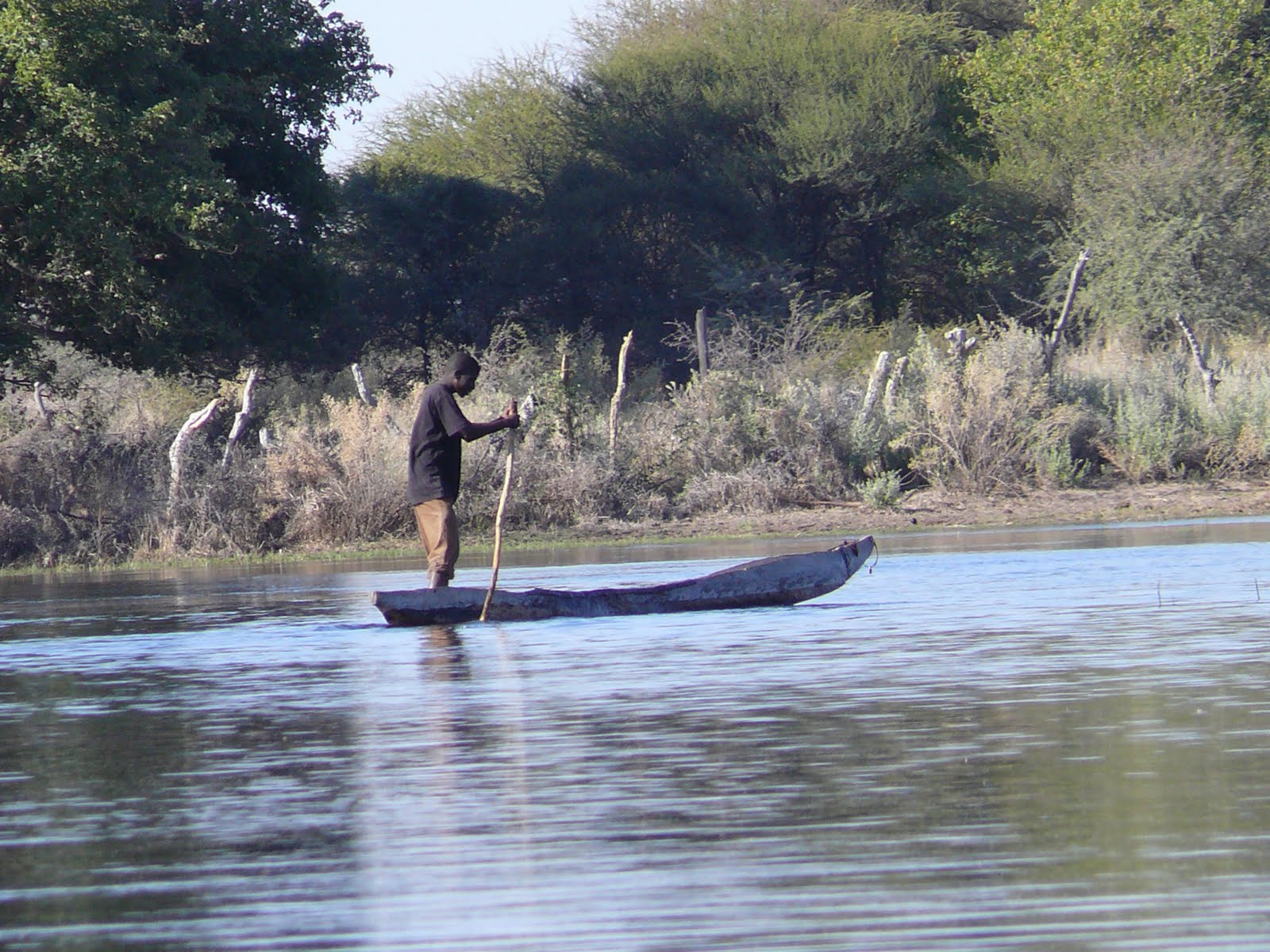
Sampling from a mokoro


Given the wet areas that my buff have been using, I have decided to try sampling from a mokoro (a traditional dug-out canoe). After asking several people about the best way to find a poler, I was told to find my way to Boro, which is reknowned as prime poler habitat. I found my way there ok (via the prison) and found lots of polers, but managed to take a wrong turn on the way back and get a little lost, although I knew I was heading in the general direction of Maun. Luckily, a happy smiley man in a Landrover found us and led us back to the outskirts of Maun. I returned to Boro the next day to pick up my poler and bring him out to HQ, getting back to the main road without getting lost.

We started poling soon after sunrise and found our way through channels and across floodplains to a total of seven points from which we collected vegetation data and samples. We saw one hippo, but it was out of the water close to one of our sites, so we were able to avoid it and had no terrifying experiences of hippo surging out of the water under our mokoro as I had envisaged. We also found a very fresh lion scat at one of our sites, but only when we had almost finished there, so we just completed the sampling. The sites used by the buff were mostly on the edges of islands, not in the middle of floodplains, and not too far from the water, so we didn't have to traipse across huge distances to reach the sites. The main grass, couch grass (Cynodon dactylon), does not seem to be appealing to them, and they appear to prefer the taller grasses on the island interiors.

I generally found the mokoro to be quite a relaxing way of getting between points, as opposed to bashing through mopane and hopping over logs in my car, which can be stressful and damaging to the vehicle. Several of the points we could not reach because of land being in the way, which makes a change! We will be going again tomorrow to get at least another 8 points, I hope.

I am getting aerial photographs of my entire study area from the University of Botswana. I am going to try and speak to some more people about using a boat to get up into the swampy areas north of Chitabe after getting them to look at the aerial photos and work out which channels may be navigable.

A big old elephant with the torn ear has been hanging around HQ recently, but he is very relaxed, so I really don't mind him being outside my door on a regular basis. There have also been zebra and tsessebe at the pan in front of camp for the last few days, which makes a lovely backdrop for lunch.

Saturday, June 7, 2008

Trying to get around water


My collared buffalo have been moving about a fair bit lately. Nokya was on the Gomoti, then moved overnight up to the Chitabe area the others were in but has now decided she preferred it on the Gomoti and has come back down. Lasanya and Chanel spent some time together in one herd and have moved quite far north into highly flooded areas west of Third Bridge and Dead Tree Island in Moremi. Bianca seems to be continuing to wander around the NG32/ Chief's Island area, though I think she might be spending a bit more time in floodplains than in mopane.

I have been speaking to various people about accessing my buffalo in the flooded areas north of Chitabe and have generally been met with disbelieving stares. It would appear that the water is too high for driving, even with a specially adapted swamp vehicle, and that the high hippo density means using a mokoro or a small boat would be fairly (read completely) suicidal. Which is encouraging.

I have also been speaking to people who work in the area, including at Chitabe, who have said I can go up there and they can show me the roads that they use so I can work out how far north I can go. Apparently, the buff move from the permanent swamps back down towards Chitabe fairly regularly. So hopefully I can sample some of the floodplains and maybe islands closest to Chitabe when the buff are using those areas. However, if this latest northwards trend continues, they may soon be leaving the country altogether.

At the beginning of this week, I drove around the bottom of the Gomoti and onto the other side, where I thought I might be able to get to some areas that one of my herds was using. However, there is still a lot of water and they are mainly grazing on islands in the middle of the Gomoti that I can't quite get to. I got some vegetation samples from locations that they walked through apparently without stopping on their way up to Chitabe that should hopefully show that there is not much grass for them to eat in the inland habitat types, which is why they are sticking to those lovely wet areas.

I have arranged with the community in the Stanley's area to go out with a mokoro and see whether I can feasibly access some of the islands that the buff over there have been using. There are several mokoro stations there and the guys must know the area pretty well, which increases chances of success, although the community guys I spoke to were quite dubious about those chances, what with hippos and some of the channels being completely blocked by reeds, but I will give it a try and see what happens. And then of course in a few weeks the flood will come in and exacerbate these issues. But with a bit of luck and trials of various access methods, I hope to be able to collect at least some data from the flood season!