Thursday, September 9, 2010

End of Fieldwork


Last week, I finally managed to remove the collar from my last buffalo, Valkyrie. I found out that Peter Perlstein (the helicopter pilot) and Larry Patterson (the vet) were both flying from Maun to King's Pool on the 3rd September to dart elephants. This took them right past my last cow, so I arranged for a quick detour and drove up to meet them at Khwai airstrip.

I am not very familiar with the Khwai area, and had no idea what to expect in terms of water. The first crossing was fine, just a small dip where the bonnet went under. The roads had clearly changed from the ones that were on my GPS, but I could hear planes at the airstrip, so I followed roads that went in the right direction. I reached a crossing that looked sandy and pretty well used, so I decided to walk it just to see how deep it got. It reached my armpits, but only for a brief dip so I risked it. It turned out to be quite a lot deeper than I had hoped, but we made it through with only shallow puddles in the footwells and a heavily thumping heart. I was about an hour early for my rendezvous with the helicopter, so I decided to try and find a better way out, as well as checking for a signal from the collar. I managed to find both, and made it back to the strip with plenty of time to spare, so I turned off my engine and waited.

Peter came in and landed at the other end of the strip, but when I went to start my engine, the starter motor just laughed silently at me. I always carry a spare, so I quickly swapped them round, then drove quickly to Peter, who had by now been waiting for about 15 minutes. He had obtained a fix from only a couple of hours before, so we flew to that fix, less than 4 km from the strip, and found the herd very easily. We spotted the collar quite quickly and separated the cow off from most of the herd, then pushed them into an open area where we could dart. Removing the collar took only a few minutes and she was up in no time. I saw that she had an old wound on her back that was not there when we darted her in January, so at some point in the last few months a lion must have tried his luck with her. However, as we all know, buffalo are tough and I have no doubt that she taught that lion a good lesson!

So for now, my fieldwork is done. I have no more collared buffalo to follow, which is a very sad state of affairs, but one that was inevitable. I am still going to be going into the bush most weekends for the next couple of months, so I will let you know if I have any more exciting adventures!

Sunday, August 22, 2010

Removing collars


I apologise for my recent lack of communication. I have been finishing up fieldwork, removing collars and organising grass samples to start analysis, as well as fitting in a couple of weeks leave.

In July, I organised for a sponsor to come out and help to remove collars from buffalo. Everything went smoothly, but actually spotting the collared animals in amongst several hundred and then getting them into position to hit the buffalo from the helicopter took a bit longer than anticipated, so we had to give up after two animals, having already gone over the sponsor's budget.

When I returned from my leave in Madagascar (where we saw 15 species of lemurs and lots of chameleons), I organised with Dane, a vet who visits every few months to dart cheaply, to remove the collar from a cow close to camp. For the 5 months before the darting date she was in open areas, so of course the night before we got to camp she missioned down into thick riparian woodland, interspersed with flooded areas. We reached the herd around 11:00 and spent the next 4 hours driving around the herd, trying to move them into more open areas, whilst not having a clue exactly where the collared animal was.

The buffalo got quite used to us, and we were able to shift them without scaring them too much, and indeed we were driving within 20 m of them without them moving off. At one point a cow was lying down 12 m from us, but of course she was completely naked and collarless. After 4 hours, I suddenly spotted the collar through the mopane leaves, and we managed to keep her within sight as I pushed them towards the open and even managed to split the herd so that she was with only a dozen other animals, including her calf. We then tried to get into a position to dart them, but they were a bit skittish and my car was overheating from all the sage. I had to stop to clean the radiator, and then we lost them for 20 minutes, by which time it was 16:30 and the sun was definitely heading for the horizon. After much swearing on my part, we found them again. They were relaxed and we just managed to drive around to a point that Dane could fire a dart into the collared cow. After that it all went very smoothly, and I stopped swearing. We removed the collar and sent her on her way.

I now have one collar left out, but the cow wearing it is fairly tiresome and seems to be determined to walk all the way around the Delta, making it difficult for me to get to her by vehicle, and expensive to reach her by helicopter - she has been about 100 km from Maun for the last couple of months.

After the darting, I went out to complete my grass sampling, alone because my assistant left in July. It was harder work alone, but quite relaxing and I definitely enjoyed pootling around on my own and enjoying the bush.

I have since moved to Maun for the last phase of my time in Botswana - analysing samples in the lab. I have managed to organise all of the samples and am now getting down to the actual analysis. I still plan to come out to the bush some weekends, and am trying to maximise my last few months here before I reluctantly have to go back to the UK in November.

Saturday, June 19, 2010

Khwai


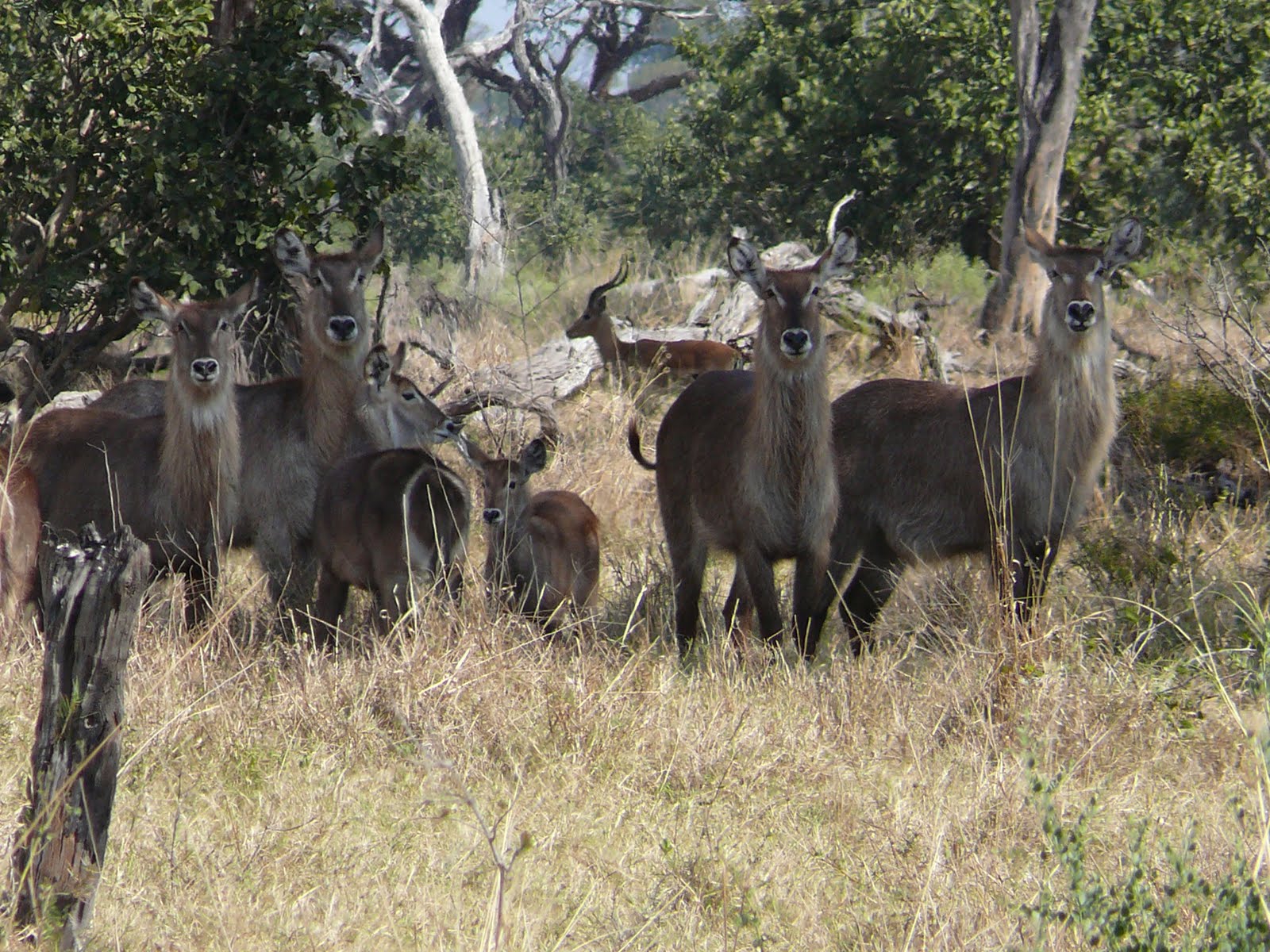
Last week, Roz and I collected some samples from both Valkyrie and Jezebel. Valkyrie chose a relatively dry area of Khwai to use, which made me rather happy. We used the eastern boundary road for Moremi, which I had not driven up before, and was mostly fine, except for some very bumpy sections that must have been a nightmare in the rainy season. Valkyrie had moved back into NG41 by this time, so we did not find any buffalo, although we did bump into several waterbuck, which was lovely as I do not get to see them very often.

At one of the points that I wanted to sample, we found a large bull elephant resting in the shade. We left that point for a couple of hours in the hope that he would move on. By the time we went back, he had only moved as far as the next tree, but looked like he might move further, so I drove away to wait for him to move on under a tree. Unfortunately it turned out that the tree I had selected was also his next target, because the next I knew was Roz saying he's here, and there he emerged from the bushes, mere metres away. It was too late to move away, and my car was not starting on the first try, so I just decided to sit and wait. He was after the camelthorn pods and when he had scooped up the ones that were already on the ground, he shook the tree for more. As he picked them up delicately one by one, he stared at us from just a few metres away. After about ten minutes, he moved on to the next tree and we went back to sample the site.

Despite a bit of waiting, we managed to get everything done in time to get back to camp that night, and then sampled a few sites used by Jezebel the next day. On the way back from Khwai, my accelerator had become stuck and was progressively getting worse, but Moses had a look at it and made a plan with something he found in the workshop. His plan stopped the accelerator sticking, but created another problem, but that was fixed this week.

I flew up to Kasane this week to give a talk to the heads of primary schools in Botswana. It was lovely to go somewhere new, and they covered all of my expenses, including a cruise on the river. I thoroughly enjoyed watching elephants chasing baboons on the bank, as for once their trumpets were not directed at me!

Thursday, June 10, 2010

Hippo Pools


Last week, Roz and I went to sample from the route that Jezebel took from her wet season home range to the flood season area. On the first day, we set out and bumped into a herd of buffalo just in front of HQ, so we got some population dynamics data from them, then continued down to Kazikini, where we sampled from the area that Jezebel had been using prior to the long distance movement. We then headed back towards HQ, but spotted a cheetah lying on the main Moremi road. We realised that there were three cheetah there - a mother and two cubs. We radio-ed Dog Camp, and they were preparing to come out and try to dart the mother, but the cheetah were in fairly dense mopane and I unfortunately lost them before the guys from Dog Camp could reach me.

The next day, we sampled further along the route, which went up to Hippo Pools, where we found another herd of buff. The area is fairly wet, so I wanted to see whether it was still possible to get to the Gomoti, or whether it was completely inaccessible. After a small amount of battling to get around water and palm scrub, we found our way around and were able to get to the channel, which is very impressive. Jezebel has since returned to the Gomoti, so being able to reach it will be useful! We came across a secretary bird trying to get comfortable in a tree.

The last day of sampling was along the Mogogelo drainage road, in the hunting area, where we managed to spot two eland running off into the bushes. We finished and were back in camp by lunchtime, after which a collared zebra was called in, keeping an eye on 6 lions eating a warthog. Hattie, the zebra researcher, was preparing to come out and dart the zebra, but they got a bit freaked out, especially after they ran into two leopards whilst evading the lions. They ran off, and Gabriel could not keep up with them, so that was another aborted darting.

Tomorrow, I am heading up to Khwai, which is where Valkyrie has been for the last few days. I have no idea what to expect in terms of flooding, but I hope to be able to access some sites at least!

Wednesday, June 2, 2010

Floods!


I realise that it has been quite a long time since my last blog. This is because I have been severely hampered by large amounts of water, both in the form of late rains and high floods. The heaviest rains fell at the end of April, filling all the pans and stimulating a new growth of annual grasses, causing the buffalo herds to stay in their wet season home range until the last couple of weeks. We have had several herds in the vicinity of my camp, but only last week did a collared animal, Jezebel, come our way. I recorded population dynamics from her herd of about 300 animals last week, but as yet she has made only one trip to floodplains that used to be grassland but have been flooded for several weeks now.

Of my other collared animals, Lilith's collar has been misbehaving for a month now, but has just started sending through occasional fixes again, so I have not entirely lost hope. However, she is on the edge of Chief's Island, and there is absolutely no way for me to drive anywhere near her. Pandora is currently taking refuge on a small island on the Boro, since her usual home range has been subjected to very high water levels - again, I cannot get to her. The last cow, Valkyrie, has been close to Mababe for the vast majority of the wet season. She has recently left the area, and has not gone to Savute as I feared. However, she is currently on the Khwai river, which was not supposed to be in my study area, and I do not know how flooded it is up there, but will soon go to try and find her.

However, as usual, my vehicle has started struggling, so I am waiting for a verdict and quote on repairs. Of course, I am coming to the end of my fieldwork, but I still need the vehicle for a few more months, and need to be able to sell it for a decent price, as I am relying on proceeds from its sale to support me for a while in the UK during the write-up.

The hydrological difficulties have meant that I have had a lot of time to read scientific articles and think about how to analyse all my data. I have also finished the first draft of my methodology chapter and am waiting for comments from my supervisor.

I will let you know if I manage to do some fieldwork!

Wednesday, April 14, 2010

Darting zebra in the Makgadikgadi


Last week, Roz and I went down to the Makgadikgadi to help a colleague, James Bradley, with zebra darting. We were slightly dubious, as the pans are notoriously sticky after rain, and the rain had certainly come down there. We had to drive through a puddle several hundred metres long just to get to the research camp, which was slightly overgrown. As we were offloading, James narrowly avoided stepping on a puff adder that was hidden in the long grass.

We started the next morning, driving several kilometres off-road in the national park to get to where several hundred zebra and wildebeest were grazing. We managed to dart all five zebra that day, with only a couple of hours spent watching James drive in circles around recalcitrant zebra before moving onto a more tractable herd. We were all very pleased with the success, no darts missed and most animals were darted from around 50 m.

It was very pleasant to be in a different area, and the pans were beautiful with water in them and green grass all around. We did get stuck once, but we were out fairly quickly, and we even drove across a wet, muddy pan without getting stuck, although the car did get covered in the mud that was flying out from under my tyres!

Tuesday, April 6, 2010

Emily to the rescue!


The end of March was supposed to be the end of the rainy season, according to my protocol, but of course the weather rarely cooperates with researchers! It feels like we have had more rain in the last couple of weeks than in the rest of the rainy season put together. The other night it rained for 6 hours, but luckily I managed to find enough containers to catch the two bucketfuls of rainwater that leaked through my roof!

On Thursday, Sven answered a radio call from Michelle, who was stuck just off the Moremi cutline. A couple of hours later, I answered a radio call from Sven, who was stuck just off the Moremi cutline. I borrowed one of Rodney's cruisers, with functioning winch, and went out to the rescue. We managed to pull Sven's cruiser out using the winch, then manoeuvred ourselves into position to reach Michelle's vehicle without getting anyone else bogged down. Sven and I agreed to use both cruisers to pull the TDi out, as it was sunken in fairly deeply. With two cruisers pulling, the TDi popped out very quickly, and we were soon on our merry way. We headed for the driest route back, via Jackal Pan, and arrived there just in time to see at least 100 elephants making their way across the pan. They took a while, so we turned and headed down the inside cutline, where an African wild cat bounded in front of the car.

Roz and I went out quickly on Sunday morning to sample from the last two sites for the wet season, which were very close to roads, which was lucky since all the pans are fuller than they have been all season and the ground off-road is generally quite wet.

Yesterday morning, Michelle and Kelly came across a hyaena and cub, which promptly bolted into a hole nearby, which turned out to be a hyaena den. We went back there yesterday evening to check it out and saw 3 adults coming up to the den. One of them was collared, but we failed to pick up a signal, so the collar might have gone down. As we were leaving, a youngster came up, with a brown body but a spotted neck, and lay at the entrance to the den. We moved off shortly after, and had a little night drive on the way back, seeing another hyaena, three wild cat and a total of 15 chameleons!

I am off to Maun this afternoon to prepare to go down to the Makgadikgadi salt pans tomorrow to help a colleague with zebra darting.

Friday, March 26, 2010

Angry hippo


Last week I decided to take Rodney up on his kind offer to lend me a vehicle from HQ, and did the fieldwork that I had wanted to do two weeks ago. We set off early from HQ on Wednesday and came across a herd of buffalo, just as they were crossing the main Moremi road. They were fairly relaxed, and I got a good count, including quite a large number of very small calves. We sampled from Jezebel, but her herd was in such thick bush that we only managed to see four animals and so we left them to it. We back onto the road close to the Kazikini hunting camp, and shortly afterwards spotted a group of eland running off into the bushes. I suspect that it was the same herd that I saw last year and Gabriel saw in January, of ten adults and 2-3 youngsters, although they were very skittish and we could not get a decent look at them. We made it to S-bend, where we were threatened by an angry hippo but managed to escape with our dignity intact. As we were heading back to camp, we spotted a big buffalo bull walking down the road towards us. I stopped and switched the car off to see how close he would get. He literally walked straight up to the vehicle and got to within 5 m before suddenly realising that we were there and moving off the road.

The next day we sampled from Valkyrie, up near Mababe. On the way in we saw a roan run across the road and we then saw a herd of 21 giraffe that also ran away from us. We managed to get all of the samples that we needed bar one, so the season's sampling is nearly done, which is a relief given that the end of the month is fast approaching!

Monday, March 15, 2010

Elephants in the bush


Last weekend I organised a fundraiser, involving a tournament of human foosball (table football), with PVC piping and rope connecting people in several lines that they were not supposed to leave. Five teams turned up and several spectators, so there were over a hundred people there, all of which said they had a really good time. We managed to raise over P3,500 in profits, and everyone said they would be keen to participate if I did it again.

On Friday, Roz and I went out to sample the last of the points for the baseline Low Mixed Woodland habitat types. We started seeing elephants almost as soon as we left camp, and managed to sneak through a breeding herd with only a couple of outraged trumpets. Shortly after we started sampling, we spotted some buffalo on the road in front of us. The vegetation was quite thick, so the only animals that we could see were the ones crossing the road. We were very patient and were rewarded by over a hundred animals walking in front of us, including several very small calves.

I was not sure how wet the area would be, and I know several roads that can be particularly tricky when wet, so I decided to play it safe and avoid those. This made the whole trip significantly longer, and we ran out of water before the end, but we did succeed in sampling all the sites that I needed to reach.

I was planning on going out this week to collect the last samples for the wet season. My car, on the other hand, had different ideas, so I am currently waiting for a new carburetor to be sent up from Johannesburg, which should arrive on Thursday. As soon as it has been fitted, I will have to dash out and complete my wet season sampling, as the rain is definitely starting to thin out.

Sunday, February 21, 2010

Misty morning


Last week, Roz and I went out to sample from three collared animals. I was considering going for the one up on Chief's Island, but after reviewing her movements for the previous two weeks, I did not think that I would get enough samples to justify the trip.

We went across to Daunara gate first, to sample from Pandora. I went that way a couple of weeks ago, and was amazed by how much higher the water level was this time. The area was fairly dry, and it did not seem like there had been much rain recently. However, one of the roads that I had hoped to take was completely flooded, with water flowing through mopane shrubs, which was rather surprising. Unfortunately Pandora herself was across this flooded area, and by the time we had negotiated it she had begun walking in what appeared to be a determined manner. Therefore we turned around and headed back out, stopping for the night close to the fence. There were two big elephant bulls in the grassland next to our campsite, but they seemed relaxed and did not bother us. In the middle of the night I was woken up by something rummaging in our vehicle. I sprang out of bed and shouted at what I can only assume was a hyaena, since I only heard the creature running away and did not get a visual.

The next day we left the campsite and found the whole world shrouded in mist, which is unusual and made for some quite surreal scenery. We drove across to the Kazikini area to sample from Jezebel. We were driving through some open mopane when Roz said she could see elephants, at the exact time that the one she hadn't seen trumpeted from 50 m to our right, as it was running towards us. Luckily it changed its mind and settled for a head shake then relaxed completely, so that we ended up sampling two points that were close together whilst watching the elephants for adverse reactions to the noise generated by our sampling techniques. We found Jezebel resting on the edge of dense mopane, and tried to get a good visual, but of course the herd kept running away into thicker vegetation. After chasing them for a suitable amount of time, I moved on to the next point, only to drive into another group. This happened several times, so the herd must have been huge, but just spread out into little pockets. At that point I was dreaming of a small personal helicopter that would allow me to fly over the herd and count them properly. One day....

We camped in some beautiful open mopane, going to sleep to the sound of hyaena calling and elephants shouting, but no one disturbed us. We drove up to Mababe and got the last few samples from Valkyrie. The vegetation up there is too dense to see anything unless it is at a pan, so we did not find her. As we were heading out, we did disturb a rather large breeding herd of elephants that were bathing in a pan. They ran off along the road, which was not particularly useful, since they then slowed and just milled all over the road. After about half an hour of waiting for them to move off, I decided to take a chance and try to drive through. We made it into the middle of the herd, then saw 4 animals walking down the road in front of us. The vegetation was elephant height, so I slowly eased myself out of the car to try and see where we were in the herd. I saw grey backs pretty much all around us, but there was nothing for it but to keep following the ones on the herd and hope that they were in a good mood. It all turned out fine and they left the road, allowing us to pass through with only one trumpet.

We are off to Maun tomorrow to extend Roz' visa and for me to organise my next fundraiser, which is to be a human foosball tournament (obviously!), taking place on the 6th March.

Monday, February 15, 2010

Caught in a storm


Last week I flew to check on the two collars that have not been working. We picked up a signal from Medusa, double beeping, about 3/4 of the way up Chief's Island. The signal was coming from a similar location to the last fix that I got from the collar, and we did not manage to see any animals, but there was only one working antenna, so getting a precise fix for the signal was difficult. That collar sent one more fix through a few days later from a different location, so it is definitely still on a buffalo. Fury, who has the other collar, has been on the other side of the Gomoti for the wet season to date, but we flew the area fairly extensively and failed to pick up any signal. That collar also managed to send a fix through a few days later, but nothing since.

On Thursday, Roz and I set out for some baseline sampling to the east of HQ. A few hundred metres along the main Moremi road, we bumped into the Matthew's pack of wild dogs, 13 individuals lying all over the road. We stopped for a little while, but they showed no sign of moving, so we drove through them slowly, causing a couple of them to actually move out of the way of the vehicle! A kilometre further down the road, we found Goose, a collared leopard, walking along and scent marking, in his usual relaxed way. We took a few pictures and kept on going, until we found a large herd of buffalo close to Pecan Pan. In typical buffalo fashion, they allowed us to get into the perfect position to view several of them walking past, then all decided to run in the opposite direction. We tried to get a decent count, but had to give up eventually.

We managed to sample 7 out of 10 sites before the rain caught us. Roz spent the last few minutes on the 8th site shouting numbers representing biomass so that I could hear them above the sound of the rain. We raced on to the next site, but the storm caught up to us. I foolishly decided that I was already slightly wet, so continuing the sampling would be fine. I was quickly drenched, and the cardboard disc that is a highly scientific tool for measuring sward roughness turned into a cardboard flop. I managed to finish the site while Roz stayed relatively dry inside the car, recording the numbers that I shouted onto a mostly dry sheet of paper. We drove on to the final site and tried to wait for the rain to stop. At one point it eased, and we got out to sample very quickly, but I realised that I could hear chewing sounds that could only be coming from an elephant, which popped out of the bushes 50m away after a few seconds. So we let him move off, by which time the rain had started again. I just wanted to get it over with by then, and it was already 17.30, so I donned Roz' waterproof (which she had neglected to mention until then!) and did the sampling as quickly as possible. By the time I was done, the rain had eased slightly, so we put on some dry clothes and headed for home. Mission accomplished!

Sunday, February 7, 2010

Sampling


Last week I went out to sample from four of my collared animals. One of them, Fury, had shown an unusual fix on the collar, which had subsequently stopped working. We started by tracking for that collar and going to the most recent fix. We did not find the collar anywhere, despite searching the ground and tracking almost constantly. We sampled from recent fixes, and ended up spending the night there, going to sleep after hearing elephants trumpeting and fighting not too far away.

The next day, we went across to the Stanley's area to sample from Pandora. We were able to get a count of almost 200 animals as they were relaxed and in open mopane with good visibility. There were several very small calves in the herd. We camped out that night as well, after being pleasantly surprised by the accessibility of areas despite significant rain. The next morning, we headed out and I caught a glimpse of the tail of a lion as it ran across the road. It turned out to be a mother and two youngsters, but they were skittish so we were unable to get photos or get close to them. We continued and found two hyaena as well.

We drove around to the area used by Jezebel, close to the Kazikini hunting camp, and picked up a signal almost straight away. The herd bolted soon after I got to them, and kept walking through dense vegetation, so I decided to cut my losses and continue grass sampling instead. We sampled several vegetation points and headed back to the road through fairly heavy rain. The next day we went up to Mababe to sample the last few points from Valkyrie, which all went smoothly. We passed several termite mounds covered in lovely butterflies.

I will try to fly this week to see if the VHF is working on either Fury or Medusa, the two collars that have stopped sending fixes, then try and find the funds to remove these defective collars.

Thursday, January 14, 2010

Collars


Last week, my assistant and I went out to sample some more wet season sites used by buffalo. We sampled from two collared animals, Jezebel and Valkyrie. Jezebel has been close to the Kazikini hunting camp lately, and we were eventually able to get the herd of about 200 animals to relax sufficiently to get close to them, but they were in fairly dense vegetation and spooked suddenly, so my count was not as detailed as I would have liked, although I did get a good visual of the collared cow, looking nice and fat, possibly pregnant.

We sampled a few sites from Jezebel's herd, then moved on to find Valkyrie. Her collar had shown some irregularities, and the only fix that I had was from the previous day, when she was in the Mababe depression, an area that I had not visited. I tried to head towards the last fix that I had, but found my way consistently blocked by the Khwai river, and areas that had been flooded by it. After several attempts to find a way around, I had to resign myself to the fact that she was inaccessible. We headed back around to the area that the collared cow had been using in the few days before, NG41. We started sampling points, and after a couple I managed to pick up a double beeping signal, which we tracked and got very close to along a road. She was in very dense bush, and for 45 minutes we tried to get a visual without success, failing to spot even one animal, let alone the collared one. I was about to give up when I decided to follow the road for a bit, and luckily it opened out on a small pan. Next to it were Valkyrie and about 27 other buffalo, quite a small herd. They were fairly relaxed, and I was able to see that the collar looked in good condition, with no obvious damages. I checked the signal, and the VHF turned off on the hour (which happens when the collar takes a GPS fix) and then came back on with a single beep. I hoped that was the end of the problem and headed back to camp. Unfortunately, the collar has since taken one fix and then stopped altogether. I have been in touch with the company and will try to arrange a darting. This is the same pattern as happened with Harpy, when the VHF stopped as well, so I am hoping that this is not the case, as finding one collared animal in dense bush will be close to impossible!

Since then, I have been helping Dog Camp with dartings, as they did not have a closed vehicle from which to dart. In three days, they have managed to change the collars on two cheetah (Lia and Franky) and one lioness (Chloe), all of which went smoothly. Lia's was slightly unconventional, in that she started to wake up a bit too soon and the collars had not been swapped. The vet got another little dose for her, but in the meantime we had to physically restrain her so that she could not get up too soon, which would have rendered the entire darting pointless.

The other animals that they are looking for have collars that are not working, so they now have to hope to bump into them. I, on the other hand, have to tow my vehicle into town, as it has developed a worrying knocking sound in the engine. Hopefully, this will be fixed soon and I will once more be driving around in the buff-mobile!

Thursday, January 7, 2010

Evil twigs

On Monday, we went out to NG32 to sample from a couple of collared buffalo. The first, Pandora, was in the area south of Stanley's. It rained a lot as we were about to leave camp, but we set out after it eased off. We got through Daunara gate without problems and started sampling. I was pleasantly surprised by the ease with which we were able to get around - there were not too many nasty muddy patches and the mopane was relatively open off road. We sampled 14 sites in that area, although Pandora had moved across very wet areas and we were unable to reach her, although we did find a beautiful moth. We camped in some lovely open mopane and listened to a lion roaring as he moved northwards throughout the night.

The next morning we sampled a couple more points, then headed back out through the gate towards Morutshe gate to sample from that area. We sampled a further 7 sites there, but again were unable to reach the buffalo that had decided to escape to the muddy floodplains. After one point, we were driving through mopane when one evil twig whipped me right in the eye. I was in quite a lot of pain and made my assistant drive us back to the road because I could not open the eye. We stopped for lunch to see if it would improve, and I was just deciding to drive to Maun to get it checked out when suddenly a relatively large piece of bark fell out of my eye and I could see again! We happily headed off to finish sampling and managed to get everything done by 5 pm. By that time a serious looking storm was building, so we decided to abandon camping and drive back to HQ. By the time we got to Shorobe, however, the sky was black and filled with lightning in all directions. Not wanting to drive back through a storm in the dark, I decided to take refuge in Maun and head out in the morning.

We will be heading out to try and find some accessible buffalo tomorrow, including one that seems to be heading to Mababe!

Friday, December 11, 2009

More migration


Last week, Roz and I went out to sample the migration route taken by Valkyrie and Jezebel. We started close to Hippo Pools, but after only 8 points sampled we fell into a hole that we failed to spot and unfortunately broke all but one blade on one side of my suspension. We crept back to camp, after managing to get hold of Gabriel, who was in town and agreed to bring a set out. We borrowed the TDi and sampled until dark, before coming back to camp, only to find that Jezebel had turned around and come back to the Gomoti when I checked the website for buffalo movements. Two of the tyres on the TDi had slow punctures the next morning and we were pressed for time, so unable to fix them and we had to borrow the cruiser. We finished off sampling the next day, taking 71 points on that route.

We high-tailed it back to camp to pick up my car, which Moses had kindly fixed while we were busy sampling, and get straight into town in time for a GIS (Geographic Information Systems) course organised by the University of Botswana for the next four days. During that course, the drag link arm on my vehicle fell off so that I had no steering, but I managed to get that fixed by the end of the course. My supervisor from the University of Bristol gave us short notice that he was coming to visit, so I met up with him and arranged to take him down to the Makgadikgadi for zebra darting with a colleague. Unfortunately the zebra refused to play and spent hours staying just out of range of the dart gun.

Two days ago, Jezebel changed her mind again and moved eastwards. Valkyrie finally decided to stay in the east, whereas Fury, the third collared animal on the Gomoti, is still showing no signs of migrating as yet.

Wednesday, November 25, 2009

Migrating Valkyrie


Valkyrie, one of my collared buffalo, decided a couple of weeks ago to migrate, which turned out to be a little early. She spent a few days in the wet season home range, then returned to the Gomoti. A couple of days later, after a storm, she left again, this time taking a much longer, more circuitous route before eventually returning to the Gomoti, not far from HQ. I wanted to sample the entire route that she had taken, to see where she had decided to stop as well as the areas that she walked through. Roz and I started this endeavour on the 6th November, following the first back and forth mission. However, we were unable to complete it because my vehicle was giving me problems, refusing to idle and consuming a lot of fuel. I decided to take it to Maun, where I hoped (in vain as it turns out!) that it would be fixed quickly. While we were in Maun, I was monitoring the movements of the buffalo, and saw that Valkyrie had set out on her second mission.

We eventually got the vehicle back on the 20th November, with a new carb, new manifold, a refurbished cylinder head and a variety of other repairs, and headed straight out to finish sampling. We spent the next four days retracing Valkyrie's route, coming out of it with close to a hundred sample sites and a decent level of exhaustion.

We were sampling along the main Moremi road when we bumped into Goose, one of the collared leopards. We followed him for a little while, as it was the first time that Roz saw a wild leopard, and she was very excited. He was checking around, but seemed more interested in marking than hunting, but when we saw him suddenly stop and look interested, we approached cautiously to see what he was checking out, and saw a herd of about 50 buffalo in front of him. He lay down and watched them, and they eventually just moved past him without worrying him at all. It was an interesting interaction, but we then left him and continued with sampling.

I have just checked the website for the latest fixes from my collars, and I see that while we were sampling, Valkyrie has gone again, this time taking Jezebel with her! I believe that I have managed to collar the most indecisive buffalo in the Delta, although it is very interesting. She (and her herd) responds almost immediately to rainfall, whereas all the other buffalo that I have collared have waited for several weeks after the first rains. I am now hoping that the rains come, so that she stays that side and I will go to sample from her latest meanderings.

Wednesday, November 4, 2009

Cheetah hunt


Last week, Roz and I went out to do some sampling not too far from HQ. When we got up to Hippo Pools, I spotted a cloud of dust that could only be from a large buffalo herd, so we went to investigate. After a few attempts at counting the herd, I managed to see the collar that had stopped working entirely, still on Harpy, the buffalo cow. I got hold of Rob Jackson the vet and Peter Perlstein the helicopter pilot, who were both free, and arranged for them to come out to help me remove the collar. I stayed with the herd, and after a few hours, the helicopter came in and landed to pick me up. Harpy was in a herd of around 500, with no working VHF, so just spotting her from the helicopter took a while. The wind was gusting so we could only dart in one direction and the herd was running all over the place. We finally managed to get a dart into her, and she went down fairly quickly. We recovered the collar and reversed her, then Rob and Peter headed back to Maun.

The next day, we went the long way round to Chitabe, to sample from a few points along the Gomoti. The area has dried up nicely, and we were able to get around without any problems, even bumping into one of the collared lionesses from Dog Camp, Chanel. We went to say hello at Chitabe, where we were well received, as always, and managed to find the wild dog pack of 22 animals before heading out.

Yesterday we went again to sample from areas close to HQ, as the previous trip was shortened somewhat by the darting. We went to Hippo Pools, and found three cheetah: Franky, Fredericks and Flojo's cub just by the side of the road. They got up and slowly walked off, so we followed and watched them climb a tree and deposit their scent marks. They kept walking and spotted some impala, which seemed entirely oblivious. They were behind a riparian tree island, and at first the three cheetah all approached together. Then Franky and the cub went to the right, while Fredericks sneaked round the other side, picking up to a trot to get round more quickly. We stayed with the others, and watched the cub hang back while Franky walked slowly towards the impala before stopping right out in the open about 100m from them. We caught a glimpse of movement and saw Fredericks trotting round the back, then the impala saw him and ran away from him, straight in front of the car with Franky in hot pursuit. Unfortunately sage got in the way of my perfect photo! The other two cheetah ran, but they all gave up a couple of hundred metres later and the impala ran off. It was an incredible sighting, both for the tactics and the proximity to the chase - the sound of their feet pounding the ground was amazing.

Valkyrie, one of my collared animals, decided on the 31st October to walk 30 km east towards the wet season range. This was after about 20 mm of rain fell over a couple of days. After spending 3 days there, she has realised her error and has returned to the floodplains. I will be going out to see if I can work out what changed her mind.

Saturday, October 24, 2009

Rhino


On Monday, Roz (my new assistant) and I headed out with the intention of sampling from three different herds of buffalo, ranging from the fence close to Daunara gate up to the top of Chief's Island. We managed to find Pandora, the first of the collared buffalo, close to the fence, in a herd of close to a thousand. When we found the herd, they were in dense mopane, but after a few minutes of following them, they relaxed and headed out into the open. Pandora was in front, leading them slowly in single file right past us, and all was well, until some at the back decided they were too far from the front and then several hundred buffalo were running and soon became invisible through the dust. I managed a decent count though, and left them to go back into the mopane.

We continued on, sampling along the way, and made it up to Stanley's camp, overtaking some trucks as they were stuck in a crossing. We went on a supposedly brief excursion with said trucks (once freed) to Baines Camp, as I was curious to see the camp and meet the managers. We spent the night close to Stanley's, after realising that there was too much water to go off-road in that area. The next morning we started up Chief's Island, only getting stuck once, when the ruts from the trucks were too deep and the diffs grounded out. We dug ourselves out fairly quickly though and continued most of the way up Chief's Island. We went off-road at a spot that I had found on Google Earth, which looked fairly clear out to the edge of the floodplains. We took a few samples, and then stopped in at Chief's Camp to visit some of my friends who are managing there.

We then started to sample at the top of Chief's Island, aiming to make our way down along the edge of the floodplains. The first part went well, and I was pleasantly surprised by how easy it was to get around. We managed to reach quite a few sampling points, although we had to drive around numerous logs and elephant holes. Most of the time we were stopped by a channel to the north, but we found a good sandy crossing point and drove through. We went a few hundred metres, and then I stopped at the sight of my very first white rhino in the Delta. He was relaxing under a tree, but got up and moved off when we arrived. We continued sampling, and managed to disturb him again a bit later on. We crossed the channel again and continued along the edge of Chief's Island. Unfortunately it became both wet and loggy so we moved inland a bit to try for a clearer space. The vegetation became denser and denser riparian, with lots of fallen trees and huge elephant holes. After battling for several hours, still being 4 km from the closest useful point and heading in the wrong direction because of ridiculously dense bush, I decided to cut my losses and try for some points at the bottom of Chief's Island.

The next morning we drove down, only to find huge expanses of flooded grassland turning into floodplain covering the road as far as we could see. So, reluctantly, I decided to leave the area and headed back to camp, arriving back last night.

Friday, October 16, 2009

Collar issues

One of my collars had stopped sending me GPS fixes at the beginning of September, but I was not sure if it was still on a cow or not. Kris, the new pilot, took me up tracking to find the collar. We had a very strong signal almost immediately, but we could not see a herd, so I took a GPS point and drove in the next day. I spent an hour listening to varying volumes of double beeps, eventually managing to locate the collar, which had exposed wires and had obviously been ripped off the animal. Although this meant that the collar was broken, that is still better than the animals neck being broken.

Another collared cow was spending some time at Hippo Pools, and Roz (my new assistant) and I went out to get population data from the herd. After an hour or so, they cooperated nicely and walked calmly in front of us so that I was able to get a near total count of the herd.

Another of my collars, which was put on in June, stopped sending me fixes on the 7th October. I went out the next day and found the herd and got a visual on the collared animal. However, whilst I was with the herd the VHF stopped working. I tried to get hold of a vet to come out and dart her, but there was no one available for several days so I had to leave the herd. I was hoping that the VHF would start up again, but several tracking attempts have resulted in failure, so the collar appears to be completely lost.

I organised a darting trip that I hoped would allow me to remove the collar described above, among other reasons. We were able to remove the collar from Bongolo, which had been on for just over a year, then put that one and a refurbished one onto new cows, Fury and Jezebel. Everything went smoothly, but there was no sign of the malfunctioning collar.

Wednesday, September 30, 2009

Elephants


Last week I sampled from a couple of collared animals that have been spending time on our side of the Gomoti. The southern section, past MTC, was still very wet, but we were able to get to a couple of points and find a herd of around 300 buff, although they were in fairly dense riparian, so we could not get a very good count from them.

The next day we headed past the Moremi cutline, towards Hippo Pools and the Gomoti northwards. We found three lionsses and two young cubs, very close to Hippo Pools. Interestingly, they had made their way down to HQ by the next day, which is at least two kilometres. We tried to reach some points towards Black Pools, but were stopped by primary floodplain. We went back around Hippo Pools to the other side, where we were able to access several points, as it was not quite as wet as I thought it would be. We also found a lovely little swimming spot, which was lovely and refreshing in the midday heat.

We made our way to the Gomoti, where we discovered hundreds of elephants. We had to wait for about an hour for a group to move away from a mud hole. One of them had a tiny calf, whilst two males were testing each other's strength. They moved off eventually, and we were able to make our way around to sample several more points. We found a beautiful big baobab that I had not noticed on previous trips, but decided to camp closer to the water. This turned out to be fortunate, as we later saw lots of elephants under the baobab whilst we were treated to fifty elephants crossing the little channel right in front of us as the sun set.

We made our way back down the next day, again dodging elephants, although there were fewer around then than during the heat of the previous day.

Janette has reached the end of her time, and is leaving today. I have managed to find another assistant, Roz, who will be arriving on the 2nd October from the UK.